Showing posts with label First Person Point of View. Show all posts

Thursday, December 16, 2010

Hunters in the Snow, Motion Picture Style

I liked this story, and I feel that it would make a fairly decent movie. My only fear is that people will think that I'm trying to make a live-action version of South Park. Between the wintery setting and the "Oh my God, they killed Kenny!" I'm sure that at least some people might try to draw the connection. On second thought, I think I'll work that line in there somewhere.

Plot!
Well, the thing about plot for a short story is that there just might not be enough of it. The average movie is around two hours long, which honestly is about half the time it took me to read this story once. We can't have people throwing down $9.50 for a movie that is going to last twenty minutes, now. Naturally, we'll need to beef up the story. All the major events should definitely stay in there, but I think it might help to have some back story. Start the story back a ways, show Tub during his daily life alone, and also focus on Kenny and Frank before they all actually meet together for the hunting trip. I think it would be helpful to reveal to the audience to reveal the vices of Frank and Tub early on so that we can see the effect that it really plays on their character. It will add some situational irony in there if we are aware of both of their vices before they ever actually reveal them to his friend. And hey, irony just makes any movie more entertaining.

Setting?
No, you have to keep this the same. This is called "Hunters in the Snow." It is not going to work in downtown Los Angeles, or the quiet suburbs of New Hampshire. Although here's an interesting idea: start the movie off in the city, or at least a somewhat modernized area. It'll show how everyone started off perfectly civilized in their own lives. But then, as the story progresses, I think it would be cool to have them moving off, farther away from this sense of civilization, moving out into the wild, until the final scene when they're driving down a deserted road lined by nothing but snow-covered trees. I feel that this would really reinforce and illustrate the theme of a fall from humanity to animality. Actually, I'm not entirely sure that's a word. I'm pretty sure it's a Mortal Kombat thing....

PointofView#
Well, the point of view may need to be tweaked. In order to make my changes to plot, the camera is simply going to have to leave Tub for a little while. In order to develop the characters of Kenny and Frank, particularly before they ever even meet up with Tub, it is going to be mandatory to split the point of view between the three of them. However, there are some things that just shouldn't be revealed. Most notable of all, I think, is probably Kenny's conversation with the elderly fellow in the house, concerning the shooting of his dog. I think that should probably remain a secret to the audience until it is revealed at the same point in the plot as it was in the story. That suddenly revelation of Kenny's true intentions is dramatic, intriguing, and central to the story as a whole, and thus should definitely not be altered.

@Characterization
Adding the many scenes at the beginning of the film, long before the main characters ever meet, should definitely help bring about the characterization of not only Frank, Tub, and Kenny, but of the many other minor characters mentioned in the story but not explicitly introduced. The interactions between Tub, Frank, and their respective wives and families, will certainly help to paint a better picture of who their characters are. In the story itself, not much is revealed about the characters, but through back story, it should be possible to round out the characters and make them seem more real. The characterization itself should serve to show how the characters begin as civilized and compassionate human beings, thus making the descent into animalistic behavior all the more dramatic and prominent.


Naturally, because I am such a fantastic movie maker, all of the changes I have added thus far should make the theme much more prevalent in the story. The theme in question, naturally is the descent from being like humans to being like animals. Frankly, I feel that it will be much easier to understand how the characters interact with each other through a deeper understanding of who they are before they ever enter the wild. Thus, this will help depict three men who are perfectly sane and functional members of society. The movie can make it much more blatant that the people are gradually losing their humanity as the story progresses. It's far easier to visualize two men leaving their friend to bleed to death in the cold when it's right up there on the silver screen than it is to do so when reading a short story. The theme will be much more prominent simply due to the fact that it is a movie. Sometimes, it is just easier to portray something like a loss of humanity through visual, non-verbal body language than it is through the written word.


Behold the Horror

Tuesday, November 30, 2010

Minority Report - The Super Post

I like to think that all of my posts are pretty super, actually.

Plot
The important thing about the plot of "Minority Report" by Philip K. Dick is the pace. The action of this story literally never stops. Ever. It's like if you just cut out all the dialogue of a Dragon Ball Z episode. You just get two shirtless men beating the crap out of each other for about 30 minutes. I'm going somewhere with this, I promise. John Allison Anderton has quite the day indeed. He gets accused of pre-murder, is kidnapped, gets caught in a car accident, breaks into Precrime headquarters, escapes via airship, rescues his wife from a mysterious assailant, assassinates an Army general, and jets off the planet. The plot never seems to slow down for more than a paragraph or two before it picks back up again, which ultimately sets the story's pace at roughly three times ten to the eighth meters per second. This pace has several effects. Most of all, it makes the story fun. Personally, I think stories with no action are just hard to read. I can breeze through an action-packed story easily, but stories full of dialogue and inner conflict just seem to draaaaag on. The story is also suspenseful. Because so much action keeps happening, the situation constantly changes. People Anderton (and therefore the reader) once suspected eventually become allies, and people he believed were friends ultimately become his enemies. Anderton initially suspects Witwer, declaring that "the set-up is fairly obvious....This will give Witwer a legal pretext to remove me right now," (p. 125) but then quickly shifts view Kaplan as the enemy, stating that "He can break the Precrime system" (p. 143). The conflict of the story shifts and bends throughout the story as the fast-occurring events change the situation. The conflict and antagonists are not always clearly defined, which makes the ending unpredictable and the story very entertaining.
Picture Pending.

Point of View
In this particular story, the point of view is called Third Person Limited, meaning that the story specifically follows one character, John Anderton, and the reader is able to discern his thoughts and feelings, but the thoughts and actions of other characters remain hidden. This is important because it gives the reader exactly as much information as Anderton is given, so we as readers suspect all the characters that he does, and we are equally surprised as he begins to uncover the truth. We are unable to see the intentions of any of the other characters, so when Anderton is convinced that he is being "framed--deliberately and maliciously" (p. 125) by Witwer, the reader trusts in his intuition and begins to suspect Witwer. However, once he discovers that "Fleming and his men were operation under Kaplan's orders," and that Kaplan had been "making sure they got him before the police," (page 141), the reader immediately begins to trust Witwer and suspect Kaplan. The point of view keeps the reader from seeing all the pieces of the puzzle until the very end and keeps the conclusion completely unexpected.
Picture Pending.

Characterization
There are exactly two ways in which people are characterized in this story. The first method applies only to Anderton. We see his actions and indirectly characterize him and get a feel for who he is. He is a man determined to survive, which is apparent by his response of "My safety" to the question of "which means more to you--your own personal safety or the existence of the system?" (p. 139). One would initially consider this to be selfish, as he has sentences countless people to detention camps for crimes they haven't committed yet, but when it comes down to it, he will not accept the fate for himself. However, this actually uncovers a strong sense of justice, based on his reasoning "If the system can survive only by imprisoning innocent people, then it deserves to be destroyed." (p. 139).Though he created Precrime, he would rather see it destroyed than have it imprison innocent people. He views himself as innocent, and therefore feels that if Precrime imprisons him, then the system is broken. It doesn't matter that he is the criminal in question; it only matters that an innocent man is being threatened with imprisonment. It just happens to be a coincidence that the only time he has considered a man's innocence is when he himself is in danger.

The second method of characterization is used to paint the picture of virtually every character who is not named John A. Anderton. Anderton literally tells the reader what to think about every person he meets. His opinions are the only things that we can use to understand the characters he interacts with. We immediately begin to distrust Witwer as Anderton blames him for the apparent conspiracy to kick him out and describes him to be as "Nice as a water moccasin" (p. 124). We also begin to distrust his wife as Anderton becomes completely convinced that she will betray him and "would describe [the card] in detail to Witwer" (p. 126). We also begin to trust Fleming, who rescues him from the car crash and from being arrested by the police. Anderton also begins to trust Kaplan, which is evident from Lisa's thought that "Probably Kaplan will protect you," (p. 138), so the reader starts to trust Kaplan as well. However all of these opinions of other people completely flip around as Anderton begins to uncover more of the story. He starts to trust Lisa, and eventually Witwer, and realizes that the true enemies here are Fleming and Kaplan. Ultimately, our view of the other characters depends totally on how Anderton feels about them.
Picture Pending.

Setting
Not much is really said about the setting. The main action takes place within some sort of city, and it is alluded that the rural parts outside of the city are locked in constant warfare. However, the important part of setting is not really the where but the when. This story, presumably, takes place sometime in the future, as apparent by such things as "precog mutants" and "airships," which as far as I know do not exist currently. The time period of this story is extremely important, as it would be impossible to create a story about Precrime in a time period where peering into the future is impossible. So the author creates his own slot in time and creates seemingly feasible technology which makes the story more realistic, rather than complete fantasy through fortunetelling and divination. Ultimately though, the setting just allows the plot to take place in a mildly realistic fashion and does not really add much to work as a whole. It could have taken place in Texas, and not a whole lot would have changed.

Theme
Oh boy, here it is, Le Pièce de résistance. I am fancy.

I have hereby discovered two distinct things, one more minor, and the other more major.

Let's start this show with the minor theme: the dangers of a strong, active military in times of peace. The army and the police force appear to be opposed to each other. Initially, the two act like they're working together to protect the public, as each keeps the other one in check, as noted by Anderton on page 122: "A duplicate file of cards pops out at Army GHQ. It's check and balance. They can keep their eye on us as continuously as they wish." The two look like they're working together, but eventually, the Army attempts to undercut the police force in a sneaky power grab, as the Army tries to discredit the concept of Precrime and dissolve the police force. The story shows just how quickly and subtly a standing Army can take over a state under the pretext of protecting the public.

The more major theme is actually a very common one, particularly amongst stories concerning things like precognition or time travel. This, of course, is the existence of free will. The concept of Precrime is based on the fact that once a person is deemed guilty of future-murder, then that person has ultimately already made the decision. Thus, the police force interferes, and actively prevents the would-be criminal from making this decision before they ever actually make it. But if that concept holds true, then does anyone really have free will? Apparently, the precogs are able to see into the future and see the decisions that somebody is going to make, implying that the future is set in stone. However, this concept is superseded by the idea that once a person becomes aware of future events, they are capable of changing the future before it happens. This also ties into the theory of Precrime in that once the police force becomes aware of the future, they are able to prevent these future events. But then this would imply that the only way that a person can have free will and the ability to control their own destiny is to be able to become aware of the future and actively prevent the events that have been predicted. This is evident from the fact that Anderton became aware of the future and thus was able to actively choose not to kill Kaplan, and then became aware of the minority report and actively chose to kill him anyway, but under different circumstances. Anderton apparently believes this as in the last few lines he notes that "My case was unique, since I had access to the data." He asserts that the only way a person can change the future is by becoming aware of the future. Otherwise, free will does not exist.

But outside of the context of the story, in this normal world where the future is completely and utterly unknown, does free will exist? Who cares? Batman is riding Superman.

Wednesday, November 3, 2010

A Rose for Emily

This story is a bit odd. I shall answer question 5: What are the advantages of first-person plural point of view in this story? What would be lost if it were told in first-person singular, by one of the townspeople or in third-person limited point of view. First-person plural (or "we") is certainly an odd point of view that one does not see often. The effect here is to show Emily as a bit of a legend. The entire town is talking about her, not just a single person. If only one person told the story, then it would lose this effect of seeming like her very presence effected the entire town. Similarly, if the point of view was from Emily's perspective, either third or first person, then the focus of the story would be primarily on what she does, the actual acts she commits, rather than how it is here where the focus is mostly on her reasoning for her actions. We would lose this sense with any other point of view, but because we see this through the eyes of the townspeople, we are able to get that "legendary" sense while also seeing her reasons.

This rose is for Emily. She received no other roses in the story.

Monday, July 5, 2010

Two - Love

In this chapter, we see the point of view shift from an omniscient outside observer to the eyes of the author himself, Tim O'Brien. I'll be honest, this shift of perspective threw me for a second, and I couldn't quite immediately grasp exactly to whom the "I" referred. Perhaps I was simply blinded by my view of Lt. Cross as the protagonist; however, from this point on, this is clearly O'Brien's story, not Cross's. Still, I think that Cross's very presence in this chapter helps ease this shift along, and makes it fairly clear that though Cross was king of the previous chapter, the story is really all about O'Brien, his personal views of the war, and the people he knew.

Another thing worth mentioning is that Cross appears to still be humping his feelings for Martha. tsk tsk. IMHO, he should probably find himself another lady to obsess over. One thing about the little Martha-Cross anecdote that I didn't quite get though was what she meant by "the things men do" (p. 28). Theory number one is that she got raped, although that's about as bluntly as one can interpret that quote. Theory number two is that she knows lots of guys with knee fetishes, which is significantly more ridiculous, but also...feasible, I suppose.


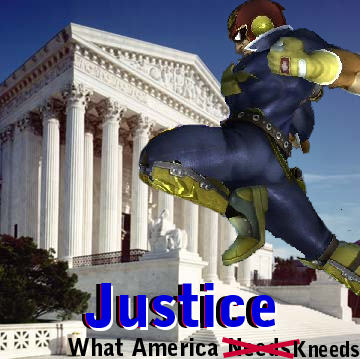
This is Captain Falcon performing a rising knee. It also includes a bad knee-related pun.